
Women Helpline Number - 1091
Students in distress due to ragging related incidents can call the
National Anti-Ragging Helpline No. 1800-180-5522 (24×7 Tollfree) or e-mail: helpline@antiragging.in
Sexual Harassment Committee
According to the University Grants Commission (Prevention, Prohibition and Redressal of Sexual Harassment of Women Employees and Students)Act of 2013, the KNIPSS Engineering Institute is committed to maintain and create a healthy, safe and conducive work environment free of sexual harassment, exploitation and intimidation for its women employees and students. At KNIPSS, we have zero-tolerance for sexual harassment. Any form of sexual harassment, particularly against women (employees and students) is not acceptable within the organization, beyond the confines of its offices, and at other locations travelled/visited for KNIPSS’s work. To ensure the above-mentioned, KNIPSS follows the 'Act' and ‘Rules’ (Policy) framed under the UGC (Prevention, Prohibition and Redressal of Sexual Harassment of Women Employees and Students) Act of 2013 through ICC. The Institute has constituted Internal Complaints Committee (ICC) which comprise of members as per the sub regulation (1) of regulation (4) of the Notification (New Delhi, the 02 May, 2016, University Grants Commission (Prevention, prohibition and redressal of sexual harassment of women)*. The policy is applicable to all the Stakeholders (explicitly or by inference) of KNIPSS, who visit KNIPSS’s and or live in its premises. All are mandated to follow this Policy and work collaboratively to prevent sexual harassment of women at KNIPSS Engineering Institute. The alteration or amendment or rescind any of the clauses through new guidelines/orders issued by Government of India regarding the Act will form part of the policy and the same will be intimated to the employees.
Responsibility of the Committee
- Develop and provide education to the students, faculty and community on the prevention of sexual harassment.
- Maintain confidential records on all allegations of sexual harassment.
- Publicly notify the provisions against sexual harassment and ensure their wide-dissemination.
- To disseminate information about the penalty and consequences of sexual harassment, information on the mechanism for Redressal of complaints pertaining to sexual harassment and contact details of members of Internal Complaints Committee, complaints procedure and so on.
- Organise Training Programmes or as the case may be, workshops for the officers, functionaries, faculty and students, to sensitize them and ensure knowledge and awareness of the rights, entitlements and responsibilities enshrined in the Act and under this regulation.
- Act decisively against all gender based violence perpetrated against employees and students of all sexes recognizing that primarily women employees and students and some male students and students of the third gender are vulnerable to many forms of sexual harassment, humiliation and exploitation.
Powers and Functions of the Committee
To ensure provision of a work and educational environment that is free from sexual harassment:
● To take all reasonable steps (active and preventive in nature) to prevent the harassment at work place.
● Obtain high level support from Director-Principal for implementing comprehensive strategy which includes:
● Develop a written policy which prohibits sexual harassment.
● Ensure that complaints processes:
● Are clearly documented;
● Are explained to all employees;
● Offer both informal and formal options for resolution;
● Address complaints in a manner which is fair, timely and confidential;
● Provide clear guidance on internal investigation procedures and record keeping;
● Give an undertaking that no employee will be victimized or disadvantaged for making a complaint.
Committee Members
Chairperson:
● Dr. Saima BadarConvener:
● Dr. Sarab Preet SinghMembers:
● Mrs. Tazeem Fatima● Mrs. Fauzia Anjum
● Mr. Rajesh Kumar Dubey
● Mr. Manoj Bhargav
● Anamika Dubey
● Miss Vaishnavi Singh
● Mr. Dharmendra Chaudhary
● Dr. Ranjana Singh
● Miss Versha Prajapati
● Miss Janhvi Singh
● Miss Akanksha Yadav
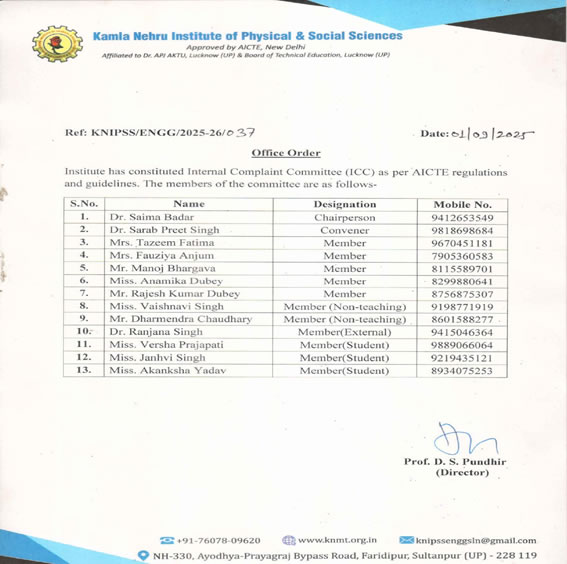
Composition of Internal Complaint committee
Internal Complaint committee policy
According to the University Grants Commission (Prevention, Prohibition and Redressal of Sexual Harassment of Women Employees and Students)Act of 2013, the KNIPSS Engineering Institute is committed to maintain and create a healthy, safe and conducive work environment free of sexual harassment, exploitation and intimidation for its women employees and students. At KNIPSS, we have zero-tolerance for sexual harassment. Any form of sexual harassment, particularly against women (employees and students) is not acceptable within the organization, beyond the confines of its offices, and at other locations travelled/visited for KNIPSS’s work. To ensure the above-mentioned, KNIPSS follows the 'Act' and ‘Rules’ (Policy) framed under the UGC (Prevention, Prohibition and Redressal of Sexual Harassment of Women Employees and Students) Act of 2013 through ICC. The Institute has constituted Internal Complaints Committee (ICC) which comprise of members as per the sub regulation (1) of regulation (4) of the Notification (New Delhi, the 02 May, 2016, University Grants Commission (Prevention, prohibition and redressal of sexual harassment of women)*. The policy is applicable to all the Stakeholders (explicitly or by inference) of KNIPSS, who visit KNIPSS’s and or live in its premises. All are mandated to follow this Policy and work collaboratively to prevent sexual harassment of women at KNIPSS Engineering Institute. The alteration or amendment or rescind any of the clauses through new guidelines/orders issued by Government of India regarding the Act will form part of the policy and the same will be intimated to the employees.
Objective of the Policy
The prime objective is to implement the Act, and thereby the Policy in its true spirit, to deal with harassment of Women Employees and Students if any in the workplace and ensure healthy work environment.Defining Sexual Harassment - “Sexual harassment” * means-
(i) “An unwanted conduct with sexual undertones if it occurs or which is persistent and which demeans, humanities or creates a hostile and intimidating environment or is calculated to induce submission by actual or threatened adverse consequences and includes any one or more or all of the following unwelcomes acts or behaviour (whether directly or by implication), namely:-
(a) any unwelcome physical, verbal, or nonverbal conduct of sexual nature.
(b) demand or request for sexual favours;
(c) making sexually coloured remarks
(d) physical contact and advances; or
(e) showing pornography”
(ii) any one (or more than one or all) of the following circumstances, if it occurs or is present in relation or connected with any behaviour that has explicit or implicit sexual undertones-
(a) implied or explicit promise of preferential treatment as quid pro quo for sexual favours;
(b) implied or explicit threat of detrimental treatment in the conduct of work.
(c) Implied or explicit threat about the present or future status of the person concerned;
(d) creating an intimidating offensive or hostile learning environment.
(e) humiliating treatment likely to affect the health, safety dignity or physical integrity of the person concerned;
Also, any definitions in context to, or connected with Prevention, Prohibition and Redressal of Sexual Harassment of Women Employees and Students will be as per the government notification*.
Responding to Conduct in Violation of Policy
If a women employee feels that she is being subjected to sexual harassment she may immediately inform it to any one of the ICC members and if not to the nearest available official person so that the compliant can be forwarded to the ICC. The ICC must conduct an immediate and impartial investigation and take appropriate action to remediate or prevent the prohibited conduct from being repeated.Complaint Resolution Procedures
Any incidence of sexual harassment is dealt with appropriately, sensitively and expeditiously and the complaints are routed through the Internal Complaints Committee. The process for complaint by aggrieved women* and inquiry by the ICC is done through the process as elaborated in the above-mentioned notification*. However, while going through the resolution procedure Institute shall ensure that the career interests of the Complainant are not adversely affected.
Confidentiality
The Internal Complaints Committee strictly ensures that the confidentiality of all the information related with complaint/case, if any is maintained. The violation of confidentiality leads to disciplinary action. Moreover, Individuals engaging in retaliatory conduct against any Complainant or person involved therein will be subject to disciplinary action by the KNIPSS’S.Duties of the Employer
Provide a safe working environment at the workplace, display at conspicuous places in the workplace the order constituting the ICC and declare names and contact details of all members of the ICC. To sensitize employees students with the provisions of the Act through Organize workshops and awareness programmes at regular intervals and to conduct orientation programmes for members of the ICC.UGC regulations-(Prevention, Prohibition and Redressal of Sexual Harassment of Women)
Handbook on Sexual Harassment of Women at Workplace
Saksham - Measures for Ensuring the Safety of Women and Programmes for Gender Sensitization on Campuses
Women Helpline Number - 1091
Students in distress due to ragging related incidents can call the
National Anti-Ragging Helpline No. 1800-180-5522 (24×7 Tollfree) or e-mail: helpline@antiragging.in